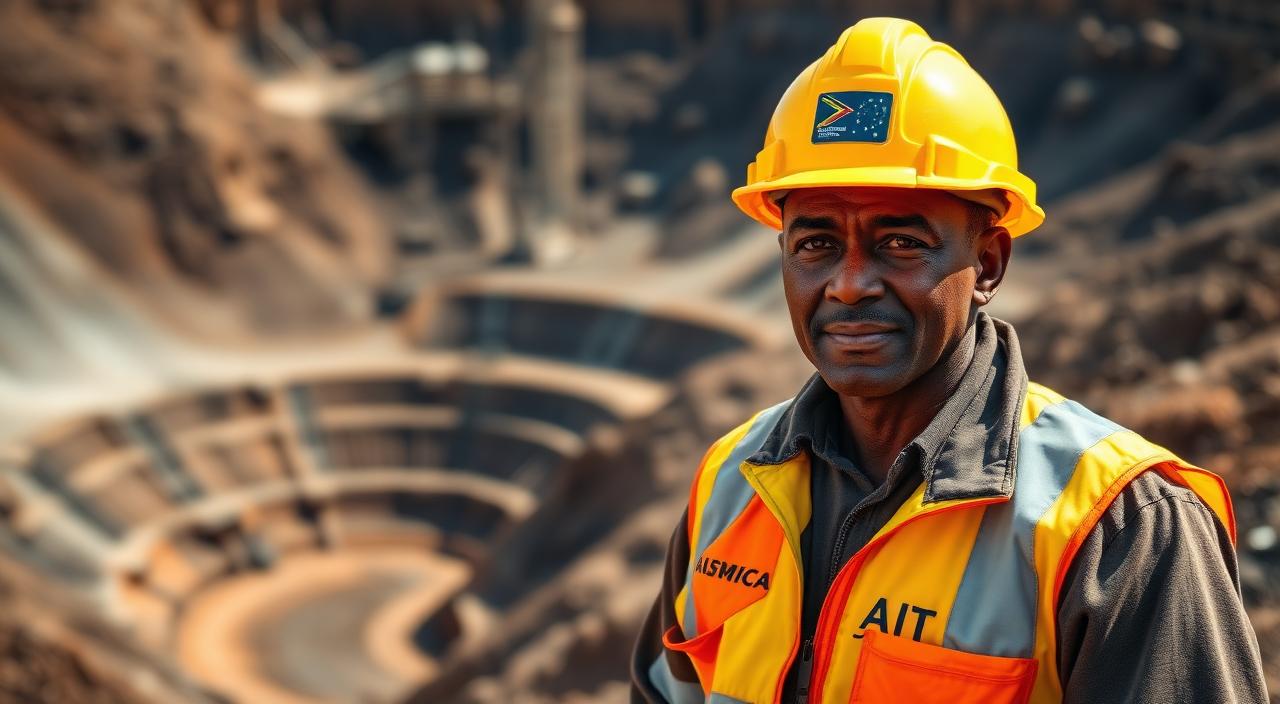
Mining is still one of the largest formal employers in South Africa, with around 470 000 people directly employed across gold, platinum-group metals, coal, iron ore, manganese, and chrome. It is also one of the few industries where a strong career — and a six-figure salary — can be built starting from a TVET qualification or a learnership, not a university degree. The work is hard, but the pathways are clearer than most office careers.
How mining careers are structured
Mines run on three broad streams that occasionally cross over: operations and production, engineering and maintenance, and technical/geosciences. Each has its own pathway. Within each stream, the ladder is well-defined — moving up tends to require a specific qualification or competency certificate at each step.
Operations and production
These are the people who actually move rock. Roles include rock drill operators, loader operators, shaft timberers, miners, shift bosses, and section managers. Entry is usually via a learnership or apprenticeship — most major mining houses (Anglo, Sibanye-Stillwater, Implats, Harmony, Exxaro) run 12–24 month learnerships every year.
- Rock drill operator: R220 000 – R320 000
- Stope team leader: R280 000 – R380 000
- Miner (with blasting certificate): R380 000 – R580 000
- Shift boss: R520 000 – R780 000
- Section manager / mine overseer: R820 000 – R1 250 000
- Mine manager (legally appointed): R1 600 000 – R2 800 000
Engineering and maintenance
Mining is heavy on machines — and heavy on the people who keep them running. Trade-tested artisans (boilermakers, fitters, electricians, diesel mechanics, instrumentation technicians) are in continuous demand and often earn more than entry-level office professionals.
- Trade-tested artisan (boilermaker, fitter, electrician, diesel mechanic): R380 000 – R620 000
- Senior artisan / foreman: R580 000 – R820 000
- Engineering technician (N6 / NQF 6): R420 000 – R650 000
- Engineer-in-training (BEng, mechanical/electrical/mining): R580 000 – R780 000
- Section engineer (qualified, GCC mines): R900 000 – R1 350 000
- Engineering manager: R1 400 000 – R2 200 000
Technical and geosciences
- Mine surveyor (in training): R420 000 – R580 000
- Geologist (BSc Geology, 2–4 years): R520 000 – R780 000
- Senior geologist / chief geologist: R900 000 – R1 400 000
- Mine planner (mid): R650 000 – R980 000
- Metallurgist: R580 000 – R900 000
How to get in without a degree
If you do not have a degree, the most common routes in are:
- Apply directly for a learnership at a major mining house (Anglo, Sibanye, Exxaro, Implats, Harmony, Kumba/AngloAmerican). Adverts run quarterly on their careers pages
- Get a trade qualification at a TVET college (NCV Engineering, N1–N6) and then apply for an apprenticeship
- Apply for entry roles at smaller contractors (Murray & Roberts Cementation, RUC, JIC) — they hire continuously and often retain top performers
What the work is actually like
Be honest with yourself before you commit. Most production roles are physically demanding, often underground or in remote locations, with long shift cycles (8 days on, 6 off; 14/7; or 28/7 for FIFO contracts). Hostels and mining towns are not for everyone. Heat, dust, noise, and real safety risk are part of the job — though the safety record of major SA mines has improved significantly over the past decade.
The flip side: roles are unionised (NUM, AMCU, Solidarity), the pay is consistent, the benefits (medical aid, retirement, education for kids) are usually strong, and the career path is clear. People who like structured progression and tangible work often thrive here.
Where mining is going in 2026
Two big shifts are already affecting hiring. First, mechanisation and automation are reducing demand for traditional rock drill operators and increasing demand for instrument technicians, automation engineers, and mine planners who can work with digital systems. Second, PGM and battery-mineral demand (lithium, manganese for batteries, vanadium) is creating new roles in process metallurgy and exploration. If you are entering mining now, lean technical and digital — the future of the industry rewards it.
Companies actively hiring in 2026
Anglo American Platinum, Sibanye-Stillwater, Implats, Harmony Gold, Exxaro, African Rainbow Minerals, Kumba Iron Ore, Glencore, Thungela, and a long list of contractors. Set up alerts on careerjunctionza.co.za for 'mining', 'metallurgy', 'rock engineering', 'mine planner', and your trade if you are an artisan.